


Shigemitsu Hamono Kurouchi Santoku 160mm
The Shigemitsu Hamono Kurouchi Santoku 160mm is a handcrafted Japanese Santoku knife forged in Shimabara, Nagasaki by the Inoue family at Shigemitsu Hamono. Hand-shaped, hardened, and sharpened by master blacksmiths, the knife combines heritage craftsmanship with modern kitchen performance. Its lightweight magnolia handle offers comfort during extended prep, while the kurouchi finish preserves the blade’s rustic character and improves food release.
About the Blade Shape: A well-balanced, all-purpose kitchen knife, santoku knives are designed for versatility across meat, fish, and vegetables. The moderately flat edge supports efficient chopping and slicing, while the compact blade length offers excellent control for everyday prep. Typically double-edged, the santoku is a reliable choice for both home cooks and professional kitchens.
| Blade Shape | Santoku | Handle Length |
130mm |
| Blade Material | Shirogami No.1 | Handle Material |
Magnolia Wood |
| Blade HRC | Handle Shape |
Oval |
|
| Blade Finish | Kurouchi | Total Length |
300mm |
| Blade Length | 160mm | Weight |
115g |
| Spine Thickness at Heel | 2.3mm | Usage |
Multi-purpose |
| Edge | Double-edge (50/50) | Origin |
Nagasaki, Japan |
| Handedness | Right hand, Left hand |
- Amakusa Red Sharpening Stone (natural stone)
- Grit: #500-#800
- Size: 150 x 45 x 30mm*
- Weight: 525 gr*
*This is a natural stone that comes directly from a quarry, so the size and weight of each stone may slightly vary.
HOW TO USE?
- Only cut food you can bite and chew with this knife since hard foods can chip the blade. Do not cut olive pits, bones, lobster shells, wood pieces or frozen food, which are especially bad due to the cold making hard steel more brittle.
- Do not use the knife in twisting motions.
- Use wood or plastic cutting boards to avoid dull knives. Do not use glass, granite or bamboo surfaces.
HOW TO CLEAN?
- After each use, hand wash the knife with mild detergent and a soft sponge, rinse with hot water and dry by hand immediately. Do not use the dishwasher.
- Wood handles may dry out over time and exposure to water. To prevent this, use some food safe mineral oil or beeswax.
HOW TO SHARPEN?
- Use the FREE WHETSONE included with the knife for sharpening. It is recommended by the manufacturer.
- Remember to sharpen both sides evenly as this is a double-bevel knife.
HOW TO STORE?
- Wrap the blade in newspaper to reduce direct exposure to the air and prevent rusting if you keep knives in a drawer or travel case.
- If you are hanging the knife or using a knife stand, remember that the blade should point downwards.
- If you are storing them in a drawer, keep the edge from touching anything else.
We offer FREE SHIPPING for all orders. We also ship worldwide from our warehouse in Japan.
After your order is confirmed, it may take up to 3-5 business days for dispatch from our warehouse.
You'll receive:
- An order confirmation email when we check payment.
- A shipping confirmation email with a tracking number once your order has shipped.
Import duties, VAT, or local customs taxes may apply once your order reaches your country.
These are set by your local customs authority and are not included in our product prices or free shipping. We suggest contacting the responsible institutions to find more information.
These fees are the customer's responsibility and thus must be paid upon delivery.
FOR U.S. CUSTOMERS: Beginning August 26, 2025, customers have reported anywhere from 20% to 80% import taxes due to changes in tariffs regulations.

AS FEATURED ON YOUTUBE
Watch the making of Shigemitsu Hamono: Father and son in Shimabara forge, harden, and sharpen by hand to make knives that keep texture and flavor.
OVERVIEW

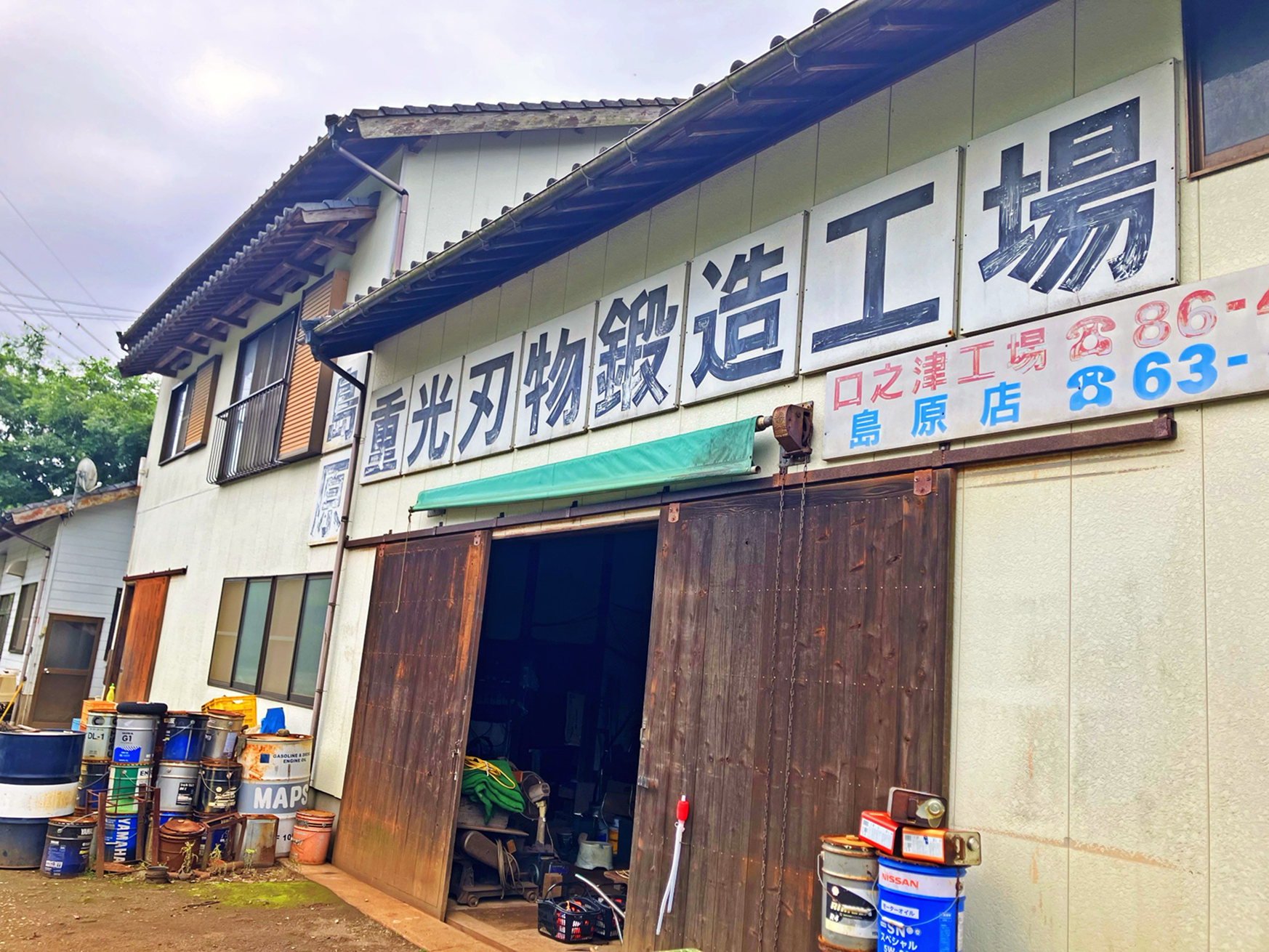
With the sea on one side and Mt. Unzen on the other, Shigemitsu Hamono has kept Shimabara’s blacksmithing spirit alive for more than a century. The forge is led by third-generation Hiroyuki Inoue, 59, who began right after high school, and his son Yuuki, 26, who followed the same path.
Their work is practical and honest: everyday kitchen knives shaped for real use. Santoku for meat and vegetables. Deba for fish, with the weight and geometry to handle mackerel or horse mackerel while still being handy for general prep. The family lost its original workshop to a mudslide during Unzen’s eruption, then rebuilt it themselves. That resilience sits inside every blade they make.
PHILOSOPHY AND PROCESS
Generations at the Anvil
Hiroyuki learned under his father by watching, not by lecture. He still measures himself against that standard and says he is trying to catch up. Yuuki is eight to nine years into the craft and gets more step-by-step coaching from his grandfather.
They both point to the long road: three years to grasp sharpening, about ten to learn forging, fifteen years at least before you feel confident. Progress is daily, not sudden. The goal is a knife that customers call easy to use and a cut that simply feels right.
Forging With Intent
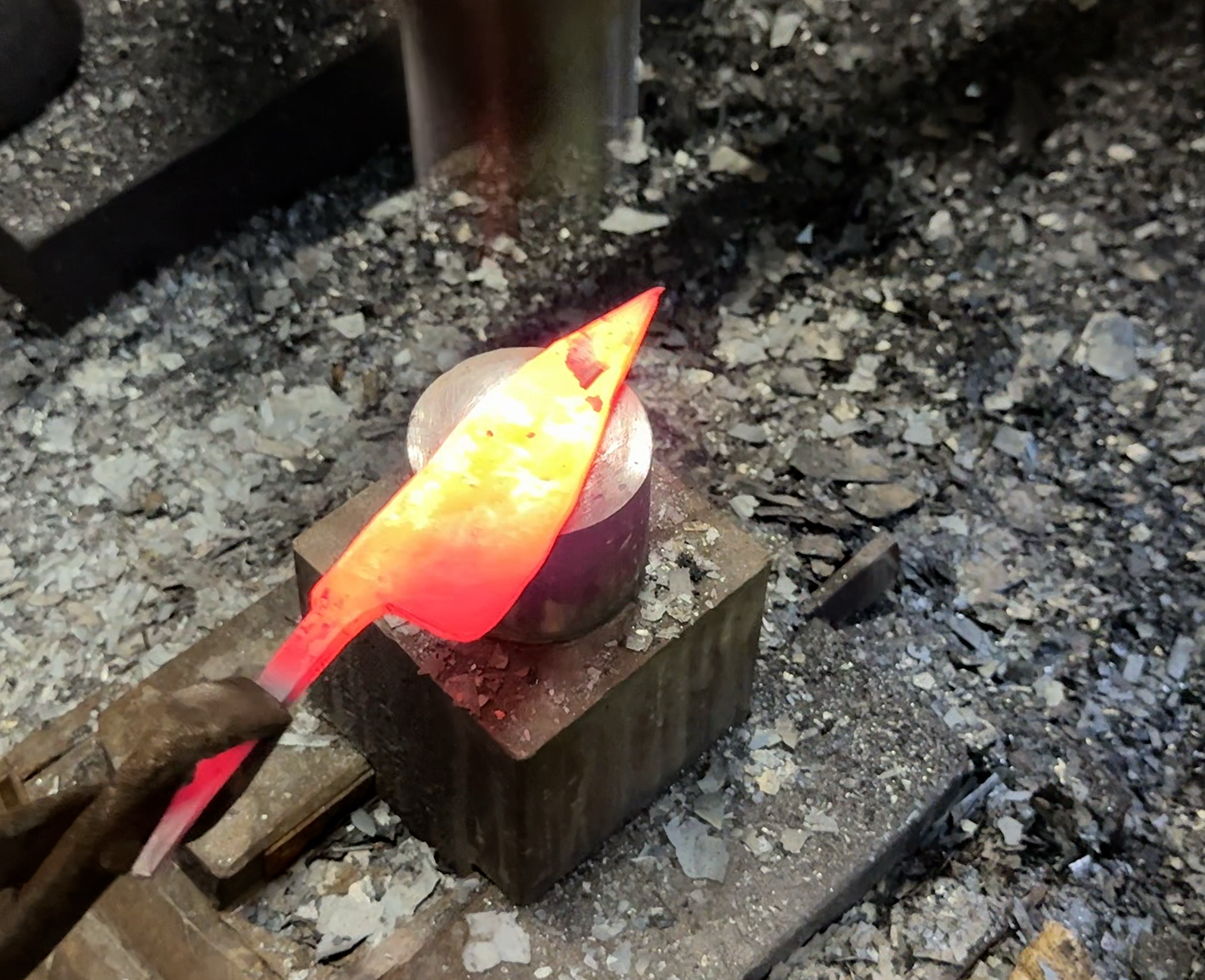
Work begins by reading colour, not instruments. Orange to yellow signals about 800°C, which is the working window. Too hot and steel can melt. The tang is drawn, then the body is stretched and shaped. Hiroyuki uses shinogi-uchi, striking in a controlled pattern so the blade takes form as it grows. Hit the edge, then the ridge. Never the soft middle.
Done well, the forged blank is already close to final size, which reduces cutting later and keeps the geometry true. Hand forging also leaves subtle undulations that help food release without added holes or grooves. They often work in batches of 100 to 200. It is not about making things cheap. It is about keeping flow and consistency.

Heat, Water, and Finish
After forging comes annealing. Heat, then cool slowly. Hardening uses warm water. Too cold and the steel does not take properly. Red clay is painted along the edge to prevent an insulating air layer during the quench.
Pine is the preferred fuel for its strong flame. The family once made charcoal themselves and plans to repair the charcoal forge. Well water is used to avoid chlorine, which can provoke rust. Grinding follows with careful heat control. Stop while the steel is red with a black tint, not yellow.
Straighten, then move to sharpening. Rough grind first, then final sharpening with Amakusa stone around the 1000 range, clean the burr, buff, and wipe dry. Safety is constant. Bits can fly from wheels, so eyes are protected and splinters are removed with care.
MESSAGE FROM THE MAKERS
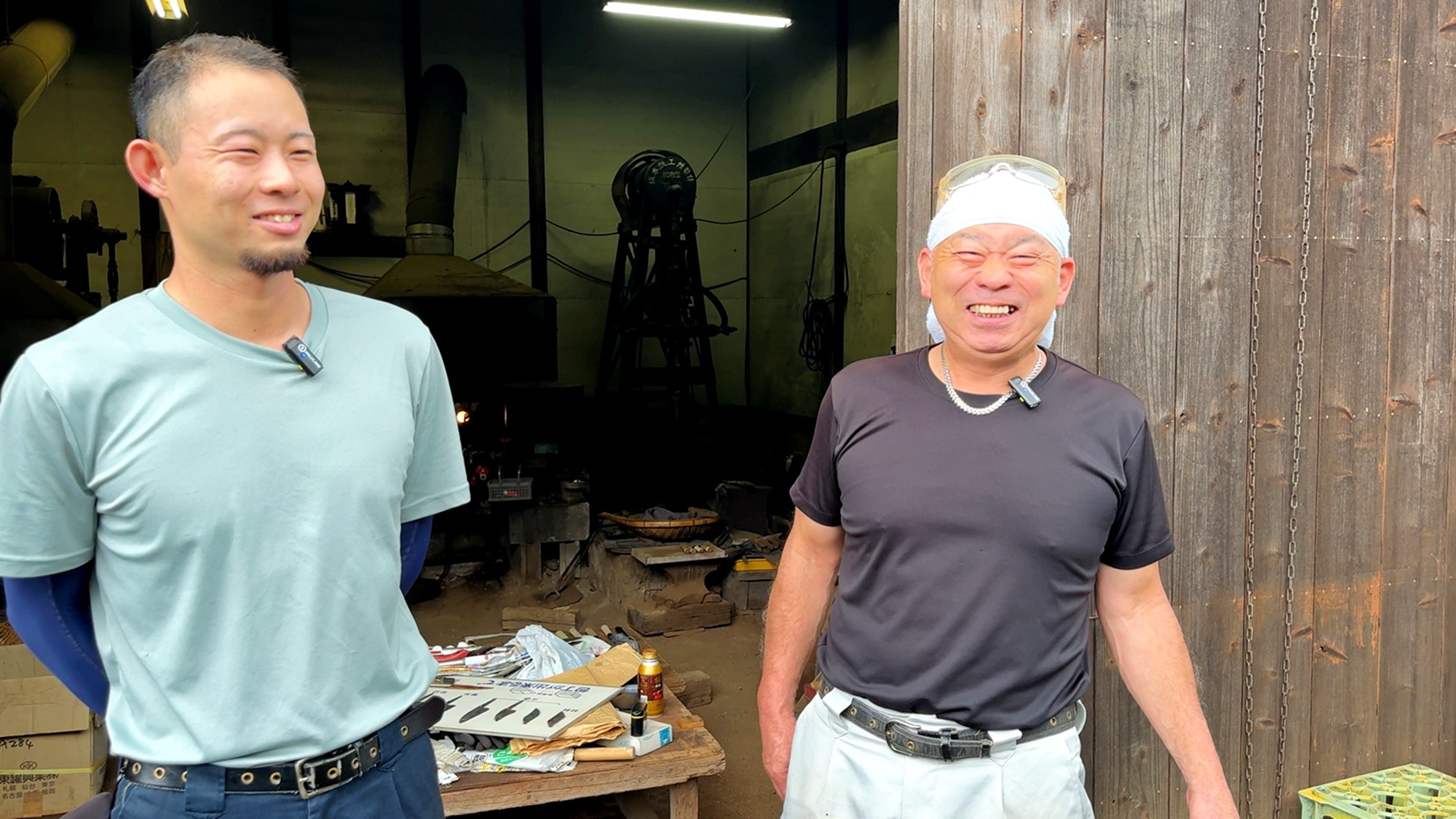
“People say, make more. We try. A knife is never finished. There is always something to improve. I learned by watching my father and I still aim to reach him.
When a customer tells us it cuts well or feels easy to use, that is enough to keep going. We rebuild when we must and we work every day to make the next one better.”
— Hiroyuki and Yuuki Inoue
FREQUENTLY ASKED QUESTIONS
Are Shigemitsu Hamono knives dishwasher safe?
No, Shigemitsu Hamono knives should not be washed in the dishwasher due to their artisanal crafting process. To prevent damage to your knife and ensure it lasts you for years to come, please wash the knife by hand with a mild detergent and gentle sponge.
How should I care for my Shigemitsu Hamono knife?
After each use, be sure to wash the knife by hand using a mild detergent and gentle sponge. Rinse clean and wipe with a soft dish towel until completely dry. Store in a dry place.
Will my Shigemitsu Hamono knife rust?
Shigemitsu Hamono knives are made of Shirogami Steel, a type of carbon steel. Thus, they are prone to rust, so be sure to dry your knife completely before putting it away and to store in a dry place to prevent corrosion.
How much will shipping cost?
All prices include FREE international shipping. Please allow up to 5 weeks for shipping, depending on your country of residence. Please see our Shipping Policy for details.
Please note: Our products ship directly from Japan to you. You may be required to pay customs duties and/or customs clearance fees upon delivery (if applicable in your country). US customers please see our Important Notice for US Customers.
How do I sharpen my Shigemitsu Hamono Knife?
Please watch the below video.
When you take proper care of your knife, it will last for decades. Apart from washing it with clean hot water, drying it off thoroughly, and placing it in newspaper to prevent rust, you need to sharpen your knife properly using a sharpening stone. And we explain you how here: